Combined Cycle Plants
Two Cycles, One Plant
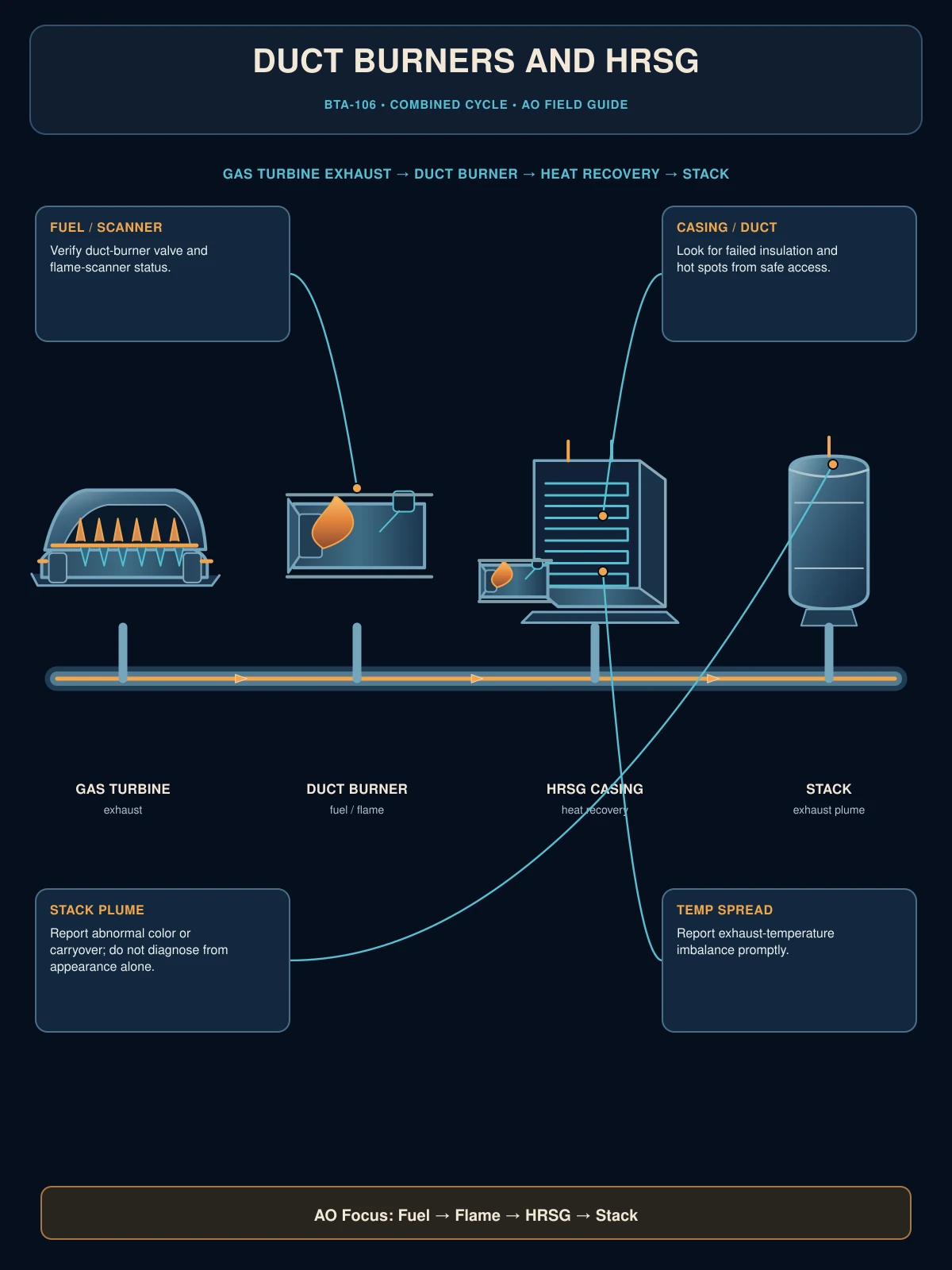
A combined cycle plant stacks two thermodynamic cycles on top of each other. The gas turbine runs a Brayton cycle — the same one you saw in Module BTA-105 — and instead of wasting the ~1,000°F exhaust up a stack, that heat is routed through a Heat Recovery Steam Generator (HRSG) to boil water into steam. That steam drives a second machine, a steam turbine, running a Rankine cycle. Two generators, one fuel input.
The payoff is efficiency. A simple cycle GT tops out around 30–40% thermal efficiency. Add the bottoming Rankine cycle and a modern combined cycle plant reaches 55–63% — among the most efficient ways to turn natural gas into electricity at scale. The tradeoff is complexity and startup time: you're now running and coordinating two turbine-generator trains, a three-pressure-level steam generator, a condenser, cooling water system, and full water/steam chemistry program, not just one gas turbine.
Combined cycle units run more like baseload or intermediate units than the pure peakers you saw in BTA-105 — steady-state rounds, water chemistry, and vacuum/condenser health become a much bigger part of the job here than they were on a simple cycle unit.
The HRSG: Where the Two Cycles Meet
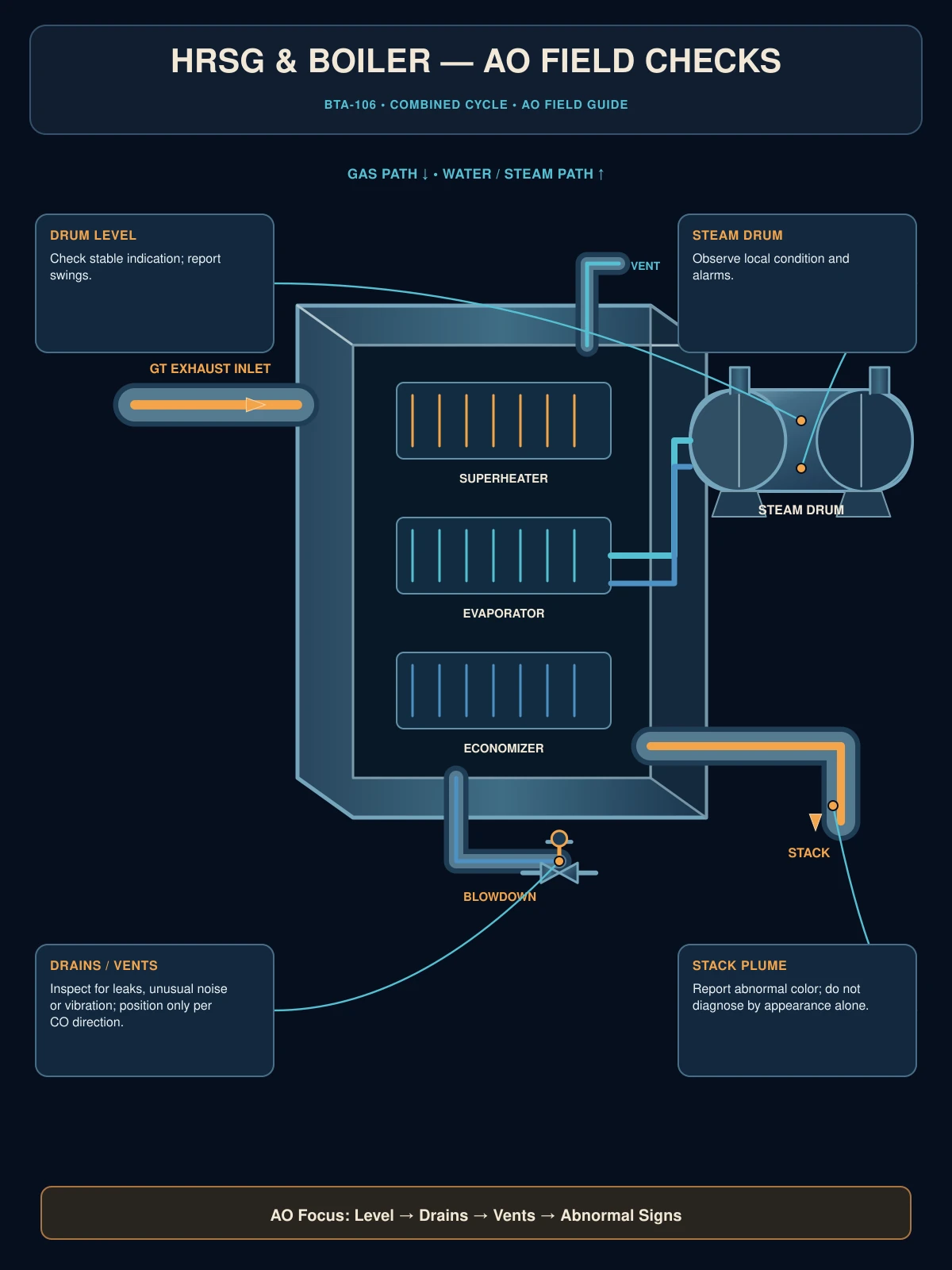
The HRSG is the single most consequential piece of equipment in the plant for an Auxiliary Operator to understand well. It's a large heat exchanger with no separate firing source (in most configurations) — it captures GT exhaust heat across a series of tube bundles to produce steam at three pressure levels:
- High Pressure (HP) — ~1,800–2,400 psig, ~1,050°F. Drives the HP section of the steam turbine.
- Intermediate Pressure (IP) / Reheat — ~500–600 psig, ~1,000°F. Reheats HP turbine exhaust before it re-enters the steam turbine's IP section — reheat is what allows the steam cycle to reach such high efficiency.
- Low Pressure (LP) — ~30–80 psig. Feeds the deaerator and the steam turbine's LP section.
HP drum level is the single most watched parameter in a combined cycle plant. Too high, and water can carry over into the steam turbine — water hitting spinning turbine blades causes immediate, catastrophic mechanical damage. Too low, and HRSG tubes can uncover and fail from overheating. Both directions are serious; this is not a "watch it eventually" parameter.
The Steam Side: Condenser, Feedwater, Cooling Water
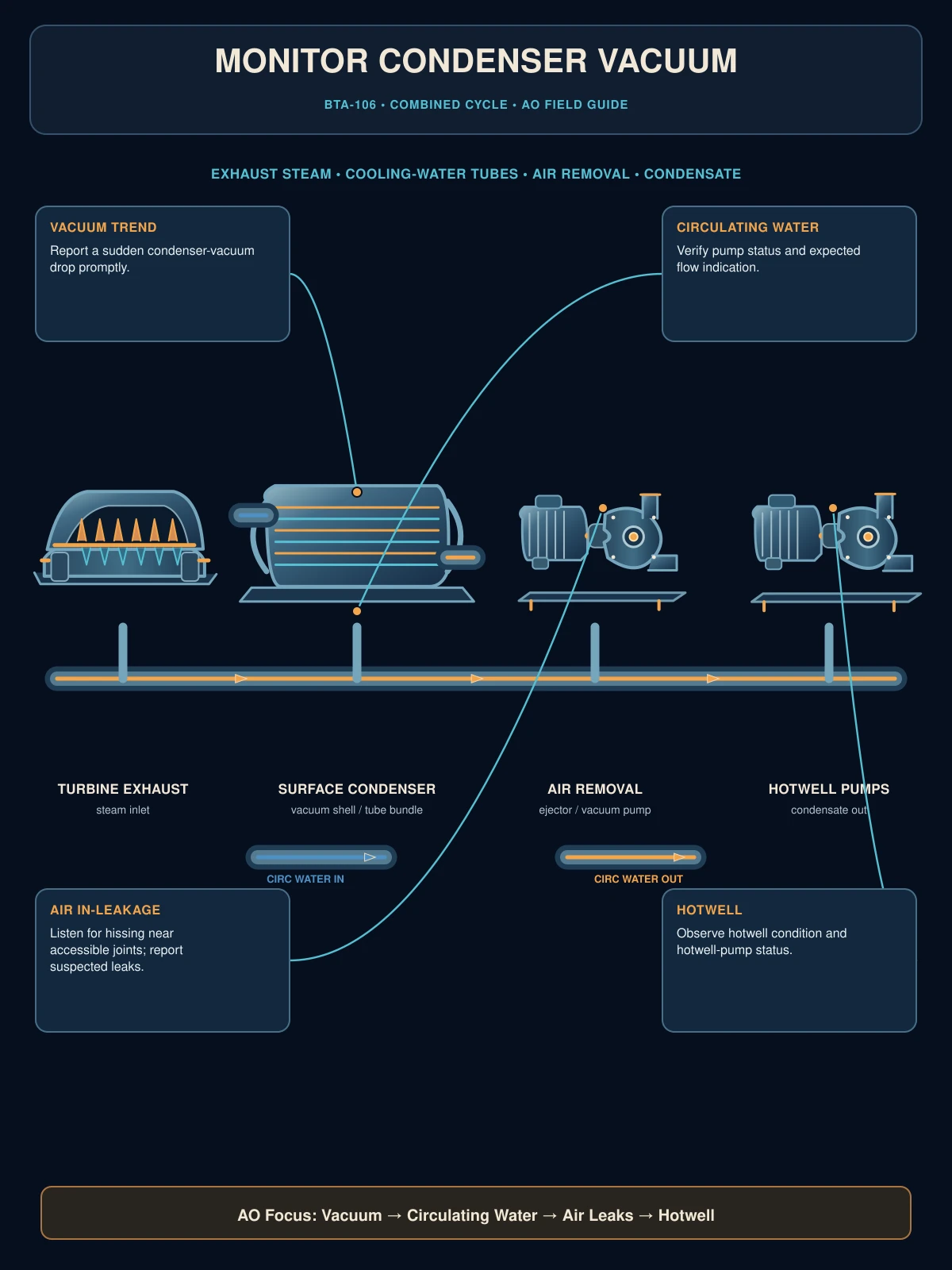
After doing its work in the steam turbine, exhaust steam has to go somewhere. It enters the condenser, where circulating water absorbs its heat and condenses it back to liquid at sub-atmospheric pressure (vacuum). That condensate is pumped back through the deaerator and feedwater pumps, returning to the HRSG to be reheated and reused — a closed loop. The cooling tower rejects the heat picked up by circulating water to atmosphere through evaporation, completing the cycle.
Every 1 inch of mercury lost from condenser vacuum costs measurable steam turbine output — this is one of the clearest, most quantifiable ways an Auxiliary Operator's rounds attentiveness translates directly into plant revenue. A slowly rising condensate conductivity, a hotwell level creeping up, or a cooling tower basin dropping are all things you'll be trained to catch before they become a bigger problem.
What Changes for the Auxiliary Operator
Compared to simple cycle, expect:
- Longer, steadier operating runs with fewer starts — but each start is more involved, coordinating GT warmup, HRSG steam production, and steam turbine roll-up in sequence.
- A heavier emphasis on water/steam chemistry — dissolved oxygen, conductivity, and drum level are now core rounds items.
- Condenser and cooling water system health as an ongoing efficiency and mechanical-integrity concern.
- More total equipment to walk down — two turbine-generator trains instead of one, plus the HRSG and its associated systems.
Ready to test what you just learned?