Loading practice lab…
Rotating Equipment Fundamentals

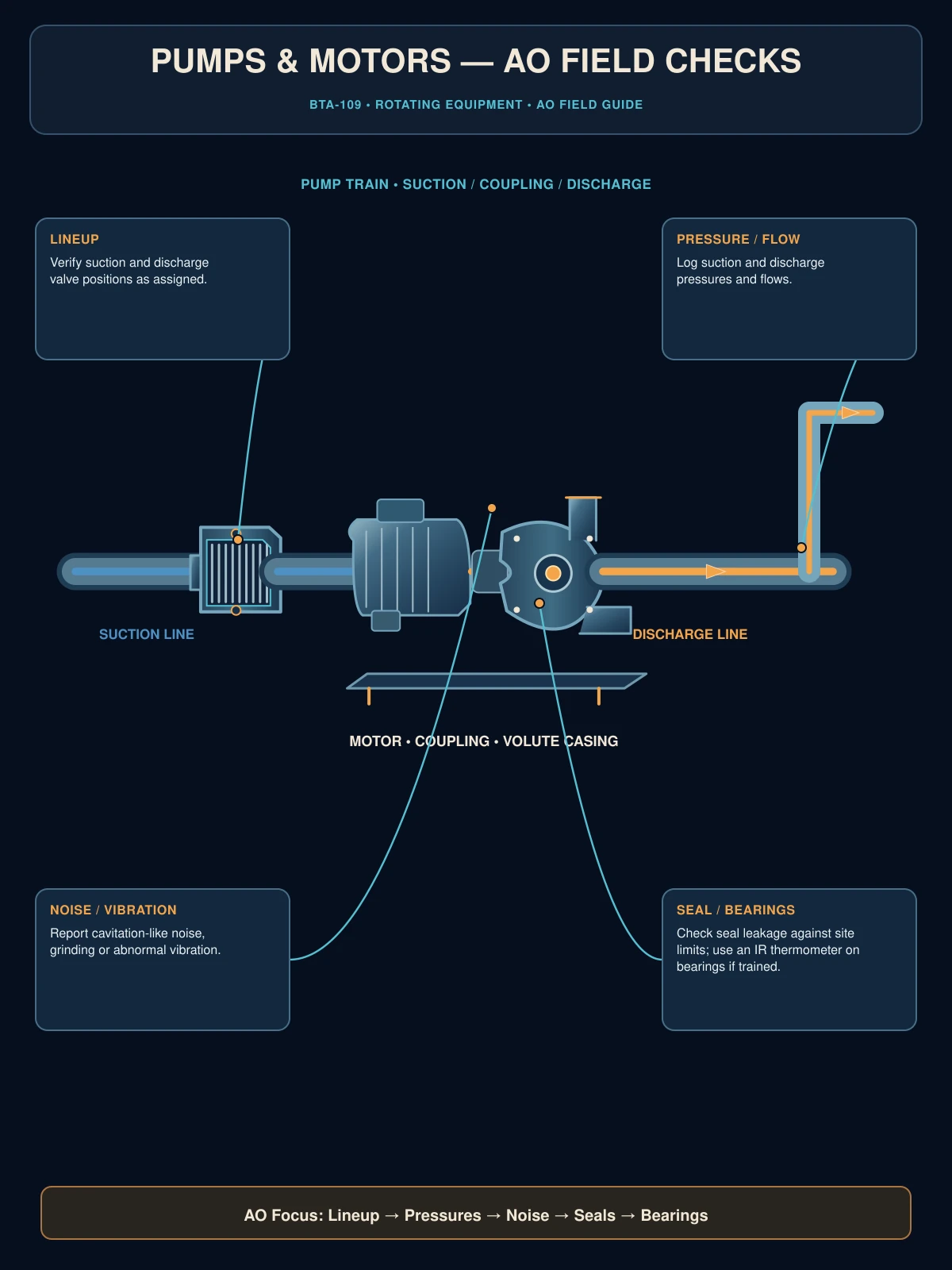
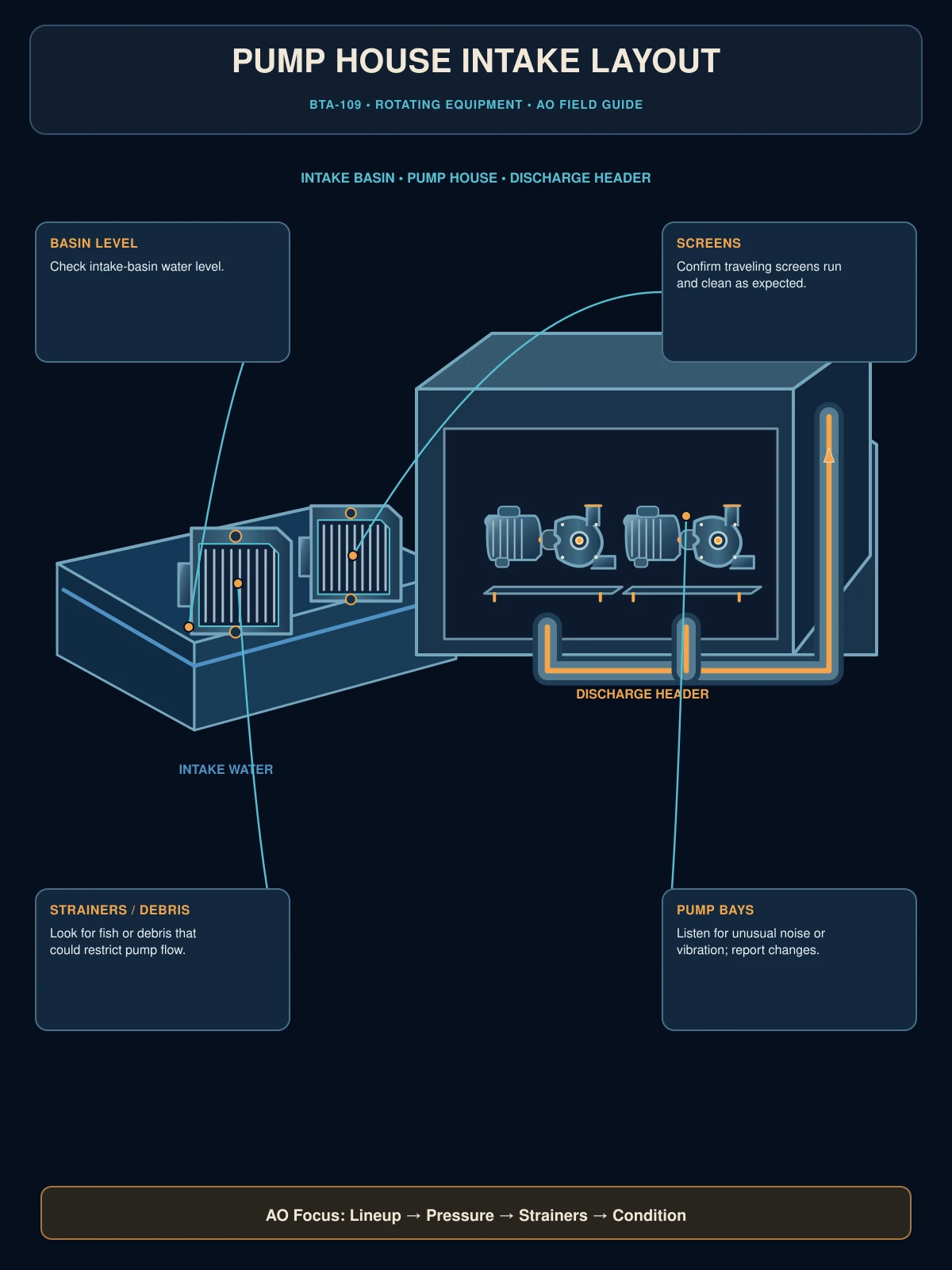
Pumps, Motors, and Fans Everywhere
Nearly every system in this course depends on rotating equipment — pumps moving fluid, motors driving that rotation, fans moving air or gas. You've encountered dozens of specific pumps and motors throughout the plant-type and core-systems modules; this module covers the underlying mechanical concepts that apply to all of them, regardless of which specific system they're part of.
Centrifugal vs. Positive Displacement Pumps
Nearly every pump you've encountered so far in this course — CW pumps, condensate pumps, boiler feed pumps — has been a centrifugal pump: an impeller spins fluid outward, converting rotational energy into flow and pressure. Centrifugal pumps are simple, reliable, and well suited to moving large volumes at moderate pressure, but their output varies with the resistance (head) they're pumping against — flow drops as discharge pressure rises.
Positive displacement pumps work differently — they trap a fixed volume of fluid and physically push it through the pump with each rotation (gear pumps, piston pumps, and similar designs), delivering a much more constant flow rate regardless of discharge pressure. They're less common in this course's major systems but show up in applications needing precise, consistent flow — some chemical feed dosing pumps, for example.
Never run a positive displacement pump against a closed discharge valve. Because it forces a fixed volume through regardless of resistance, pressure builds rapidly and catastrophically if there's nowhere for the fluid to go — this is exactly why PD pumps require a relief valve on their discharge. A centrifugal pump behaves very differently against a closed valve (zero-flow operation can overheat or damage it; any permitted duration must come from the manufacturer and plant procedure) — knowing which type you're dealing with matters.
Motors: The Common Driver
Most pumps and fans in this course are driven by induction motors — AC motors where current induced in the rotor (rather than supplied directly to it) creates the rotating magnetic field that produces torque. This is the workhorse motor design throughout industry: rugged, simple, and requiring no electrical connection to the rotating part at all, which is a major reliability advantage.
Couplings and Alignment
A coupling connects a motor shaft to the driven equipment's shaft, transmitting rotation between them. Proper alignment — ensuring both shafts are truly concentric and parallel — matters enormously: misalignment creates continuous stress on bearings, seals, and the coupling itself, showing up as vibration and premature wear that otherwise seems to have no clear cause. Alignment is typically a maintenance task, but recognizing vibration that might trace back to alignment is squarely within an Auxiliary Operator's rounds awareness.
Bearings: Supporting the Load
You've already met bearings extensively through the lube oil discussions in earlier modules. Two broad categories exist: rolling element bearings (balls or rollers reducing friction between rotating and stationary parts) and journal (sleeve) bearings (a rotating shaft supported on a thin film of oil, common in larger turbines and generators). Both require proper lubrication; a journal bearing in particular depends entirely on that oil film — losing it, even briefly, causes metal-to-metal contact and rapid damage.
Seals and Packing
Wherever a rotating shaft passes through a stationary housing, something has to prevent fluid from leaking out along that shaft while still allowing it to rotate freely. Mechanical seals use precisely mated rotating and stationary faces to contain fluid with minimal leakage; packing (softer, compressible material around the shaft) is an older, simpler technology that typically allows a small, intentional amount of leakage for cooling and lubrication of the packing itself. Neither should leak excessively — a mechanical seal leaking noticeably usually indicates a failed or worn seal face, while packing leaking heavily (versus a normal slight drip) usually means it needs adjustment or replacement.
Vibration, Balance, and Cavitation
You've encountered vibration monitoring throughout this course as a key rounds parameter (BTA-118). Unbalanced rotating components, misalignment, worn bearings, and cavitation are among the most common root causes. Cavitation — which can occur in pumps and other fluid equipment — occurs when local pressure at the pump inlet drops low enough for vapor bubbles to form in the liquid, which then collapse violently as they reach higher-pressure regions inside the pump, causing a distinctive rattling or "pumping gravel" sound and, over time, physical pitting damage to the impeller.
NPSH: Why Suction Conditions Matter
For suction-related cavitation, Net Positive Suction Head (NPSH) describes suction total head above the liquid's vapor-pressure head. Available NPSH depends on the system; required NPSH depends on the pump and operating point. The required margin must be checked against manufacturer guidance. A published NPSH value is not necessarily a no-cavitation threshold. This is exactly why low suction pressure, low tank/vessel level, or elevated fluid temperature are all conditions worth watching on rounds — they directly affect a pump's NPSH margin.
Explore the pump cutaway.
Ready to test what you just learned?