Simple Cycle (Gas Turbine) Plants
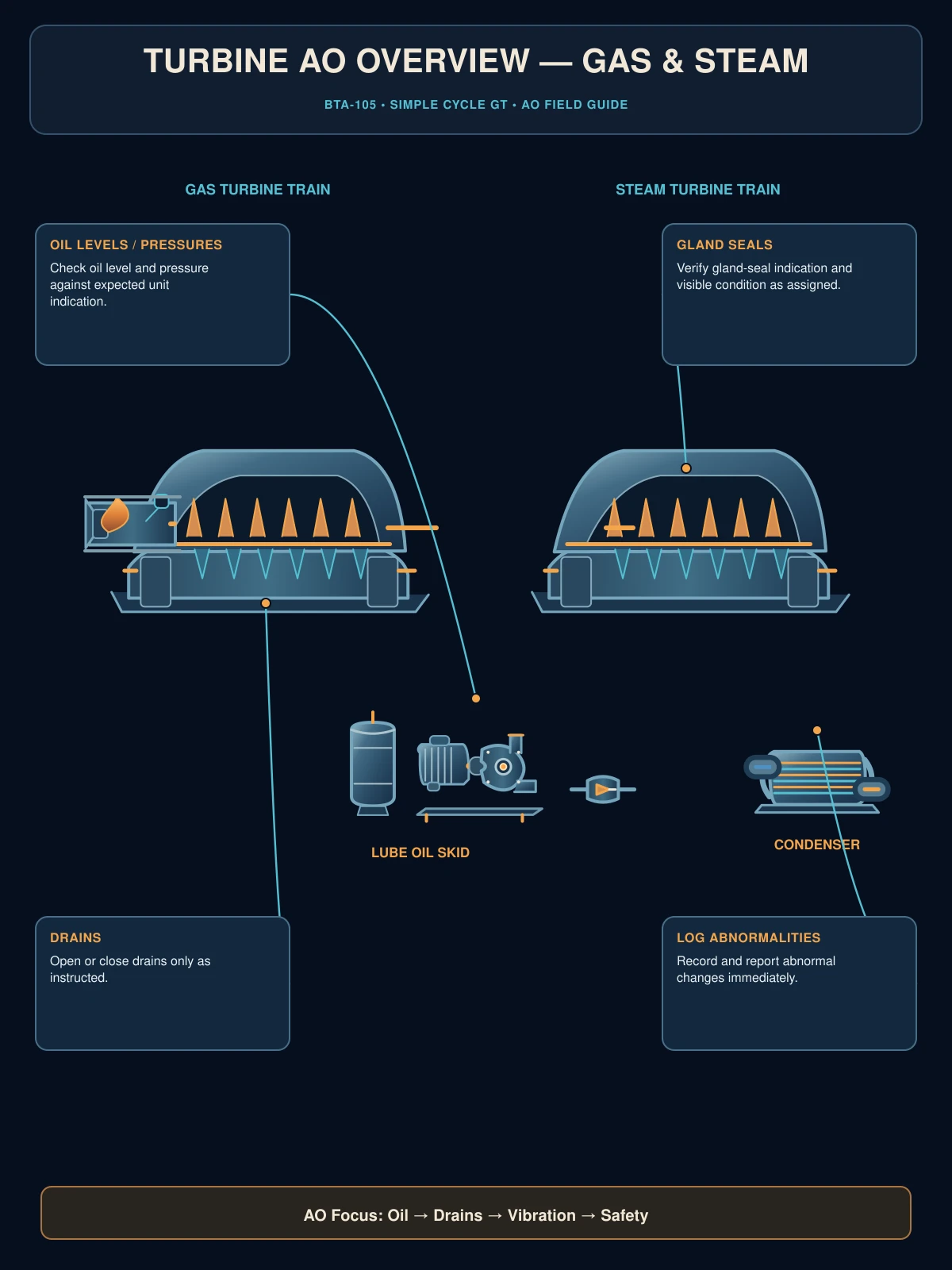
What "Simple Cycle" Means
A simple cycle plant runs a single thermodynamic cycle — the Brayton cycle — with nothing downstream to capture the leftover heat in the exhaust. Air is compressed, fuel is burned, hot gas expands through a turbine, and everything left over goes straight up the stack. That's the whole plant. Compare that to a combined cycle plant, where the same gas turbine exhaust is routed through a Heat Recovery Steam Generator (HRSG) to make additional power from a steam turbine. A simple cycle plant skips that second step entirely.
That trade-off is deliberate. A simple cycle plant is less efficient (typically 30–40% thermal efficiency versus 55–63% for combined cycle) but it's cheaper to build, faster to start, and far more flexible in how quickly it can respond to grid demand. That combination makes simple cycle plants the workhorses for peaking service — running a few hours a day, or only a few dozen days a year, to cover demand spikes that baseload and combined cycle units can't chase fast enough.
Because simple cycle units start and stop far more often than combined cycle or steam units, an Auxiliary Operator here spends more time on starts, trips, and post-trip walkdowns than on steady-state rounds. Thermal cycling also means more attention to expansion joints, casing temperatures, and vibration trending — components that fatigue faster with frequent starts.
The Brayton Cycle in Practice
The cycle has three continuous stages happening simultaneously, not in sequence like a batch process:
- Compression — Ambient air enters through inlet filters and is compressed through an axial compressor, typically 15–18 stages, raising pressure to 15–20+ times atmospheric and heating the air to 700–900°F purely from compression work.
- Combustion — Compressed air enters the combustor, where fuel (almost always natural gas, sometimes distillate oil as backup) is injected and burned continuously. Firing temperatures on modern F-class and H-class turbines reach 2,300–2,900°F.
- Expansion — The hot, high-pressure gas expands through the turbine section, spinning the shaft. Roughly 60% of that turbine work goes right back into driving the compressor — only the remaining ~40% is available to drive the generator.
Because the compressor consumes most of the turbine's own output just to run itself, small efficiency losses compound. A few percent of compressor fouling from dirty inlet air doesn't just cost a few percent of output — it can cost a disproportionate share of net plant output. This is why inlet air quality is one of the highest-value things an Auxiliary Operator monitors on a GT unit.
Major Systems an Auxiliary Operator Will Touch
Click through the interactive diagram for full detail on each system, but at a high level, your rounds on a simple cycle unit will typically cover:
- Inlet air system — filters, and on many units, evaporative coolers or inlet chillers that boost output on hot days by increasing air density.
- Fuel gas system — pressure-reducing and metering skids, and fuel gas performance heaters that raise gas temperature to protect combustor hardware and improve heat rate.
- Lube oil system — a single console typically services compressor, turbine, and generator bearings. Oil temperature, pressure, and level are core rounds checks.
- Starting system — most large units use a Static Frequency Converter (SFC) or a diesel/motor-driven starting device to bring the shaft up to firing speed before fuel is introduced.
- Generator and step-up transformer — the electrical path from shaft to grid.
Starts, Trips, and Why They're Different Here
A cold start on a large frame gas turbine can go from turning gear to full load in under 30 minutes — some aeroderivative units in under 10. That speed is the entire value proposition of simple cycle: fast response to grid dispatch. But it comes with real operational risk. Thermal transients during rapid starts stress rotating components, and combustion dynamics during the light-off and acceleration sequence require close monitoring for flame stability, exhaust spread (the temperature difference across exhaust thermocouples, which indicates uneven combustion), and vibration.
As an Auxiliary Operator, you won't typically be the one commanding a start from the control room — that's the Control Operator's job — but you are very often stationed locally during starts to watch for leaks, unusual sounds, smoke, or vibration that control room instrumentation might not catch immediately. Your eyes and ears in the field during a start are a real layer of protection.
During a start, position yourself where you can see the unit but stay clear of exhaust discharge, blast panels, and any area your site's start-up procedure designates as a keep-clear zone. Know your escape route before the sequence begins, not during it.
Ready to test what you just learned?