Electrical Systems: Breakers, Switchgear & MCCs
Following the Voltage Down
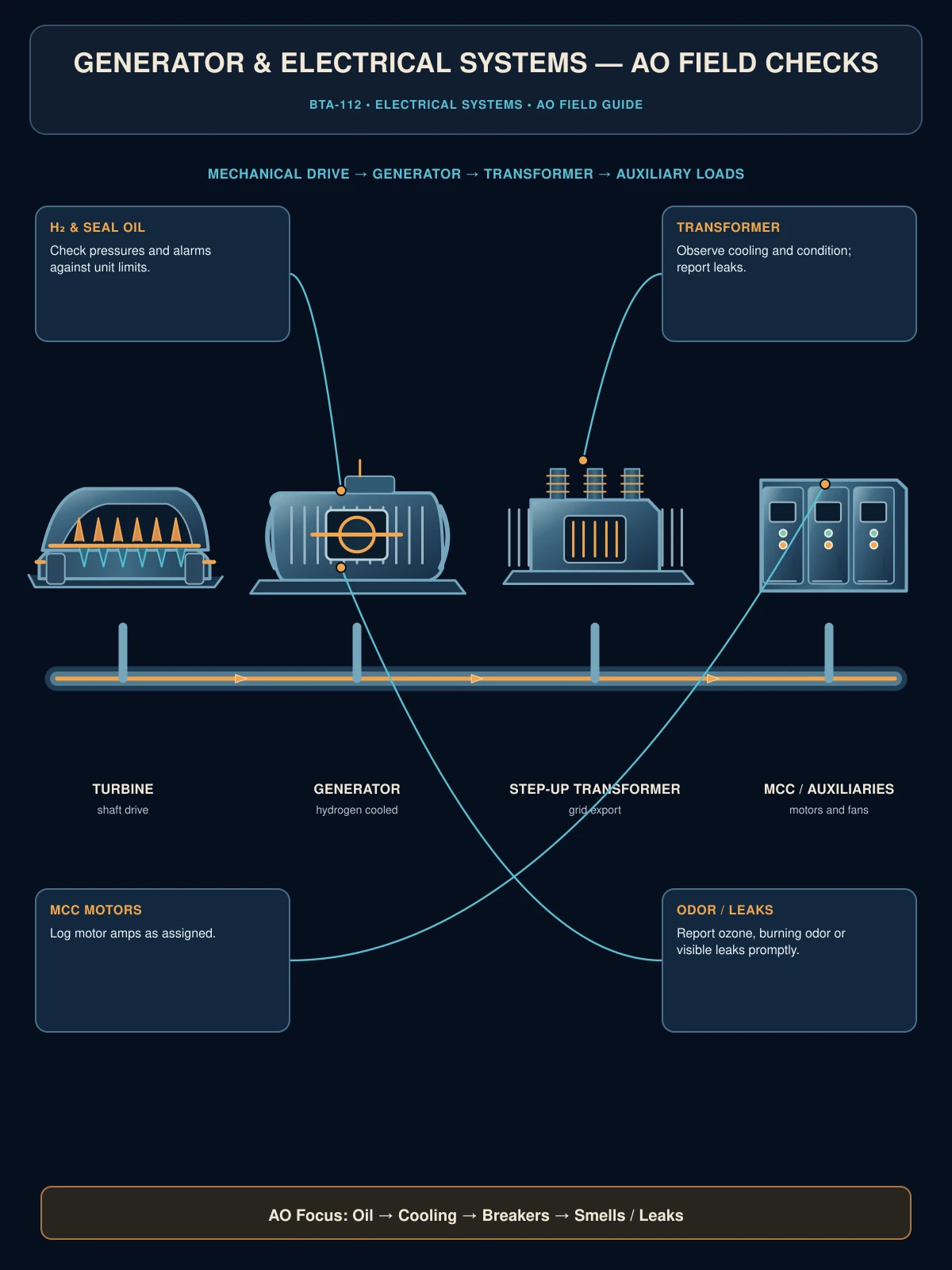
Every plant has a voltage hierarchy, stepping down from the generator to the equipment that actually uses power. A generator produces power at somewhere between 13.8 kV and 22 kV, most of which gets stepped up further by the Main (Generator Step-Up, or GSU) transformer to transmission voltage — 115 kV, 230 kV, or higher — for delivery to the grid. But the plant also needs to run its own pumps, fans, and motors, and those don't run at transmission voltage. A portion of generator output (or sometimes power pulled back from the grid) is instead stepped down through an auxiliary transformer to a level the plant's own equipment can use.
That auxiliary power typically lands at 4,160 volts (4160V, sometimes called "4kV") — the standard medium-voltage level for large plant motors: boiler feed pumps, circulating water pumps, large fans, and other big mechanical loads. From there, it steps down again, usually to 480 volts, for smaller motors, lighting, and general plant loads distributed through Motor Control Centers.
You don't need to be an electrician to work safely around this equipment, but knowing the voltage hierarchy — what's 4160V versus what's 480V versus what's at transmission voltage — tells you immediately how seriously to treat a piece of gear before you're anywhere near it.
Switchgear: Where 4160V Gets Distributed
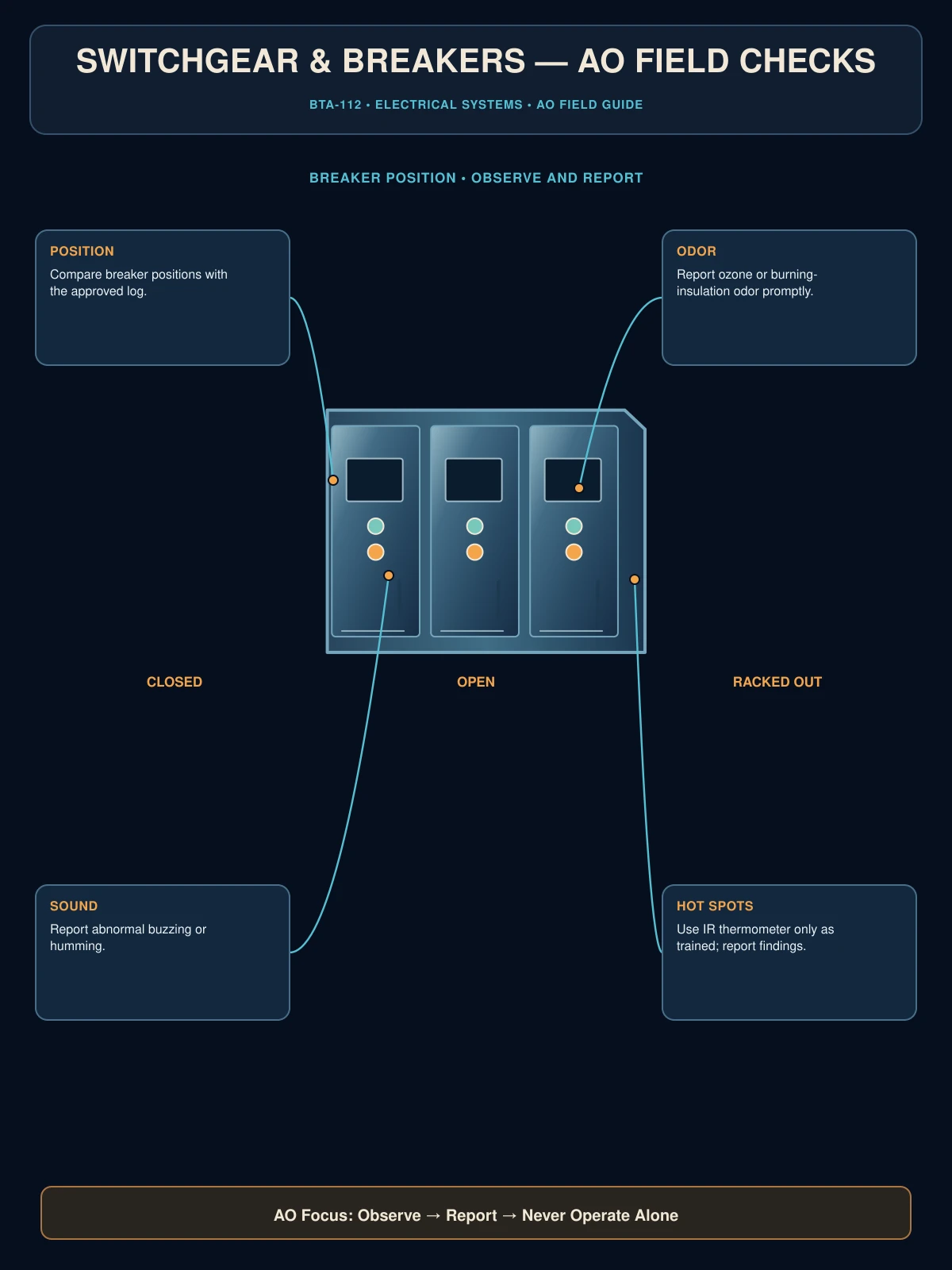
Switchgear is the assembly of circuit breakers, buses, and protective equipment that distributes medium-voltage power (typically 4160V in a plant setting) to major loads. Each breaker in a switchgear lineup, called a "cell" or "cubicle," controls power to one specific load or feeder — a boiler feed pump, a large fan motor, or a downstream transformer feeding an MCC. Switchgear breakers are substantial pieces of equipment, often drawn out on wheeled carriages so they can be racked out (physically disconnected) for maintenance, separate from simply being opened electrically.
Breaker Types You'll Encounter
- Air Circuit Breakers (ACB) — use air as the medium to extinguish the electrical arc when interrupting current. Common in lower-voltage applications (480V and below).
- Vacuum Circuit Breakers (VCB) — interrupt current inside a sealed vacuum bottle, which extinguishes the arc extremely effectively. The standard choice for medium-voltage switchgear (4160V and similar) in modern plants.
- SF6 Circuit Breakers — use sulfur hexafluoride gas as the arc-extinguishing medium, common at higher transmission voltages in the switchyard.
Regardless of type, every breaker does the same fundamental job: it can carry normal load current continuously, and it can interrupt (open under) fault current — a short circuit — fast enough to protect equipment and people before serious damage occurs.
Protective Relays: The Brains Behind the Breaker
A breaker doesn't decide on its own when to trip — a protective relay monitors current, voltage, and other electrical parameters continuously, and sends a trip signal to the breaker when it detects a fault condition (like a short circuit or an overload) that exceeds its programmed settings. Modern relays are digital, multi-function devices that can detect many different types of faults and often record detailed data about what happened at the moment of a trip — extremely valuable for troubleshooting after the fact.
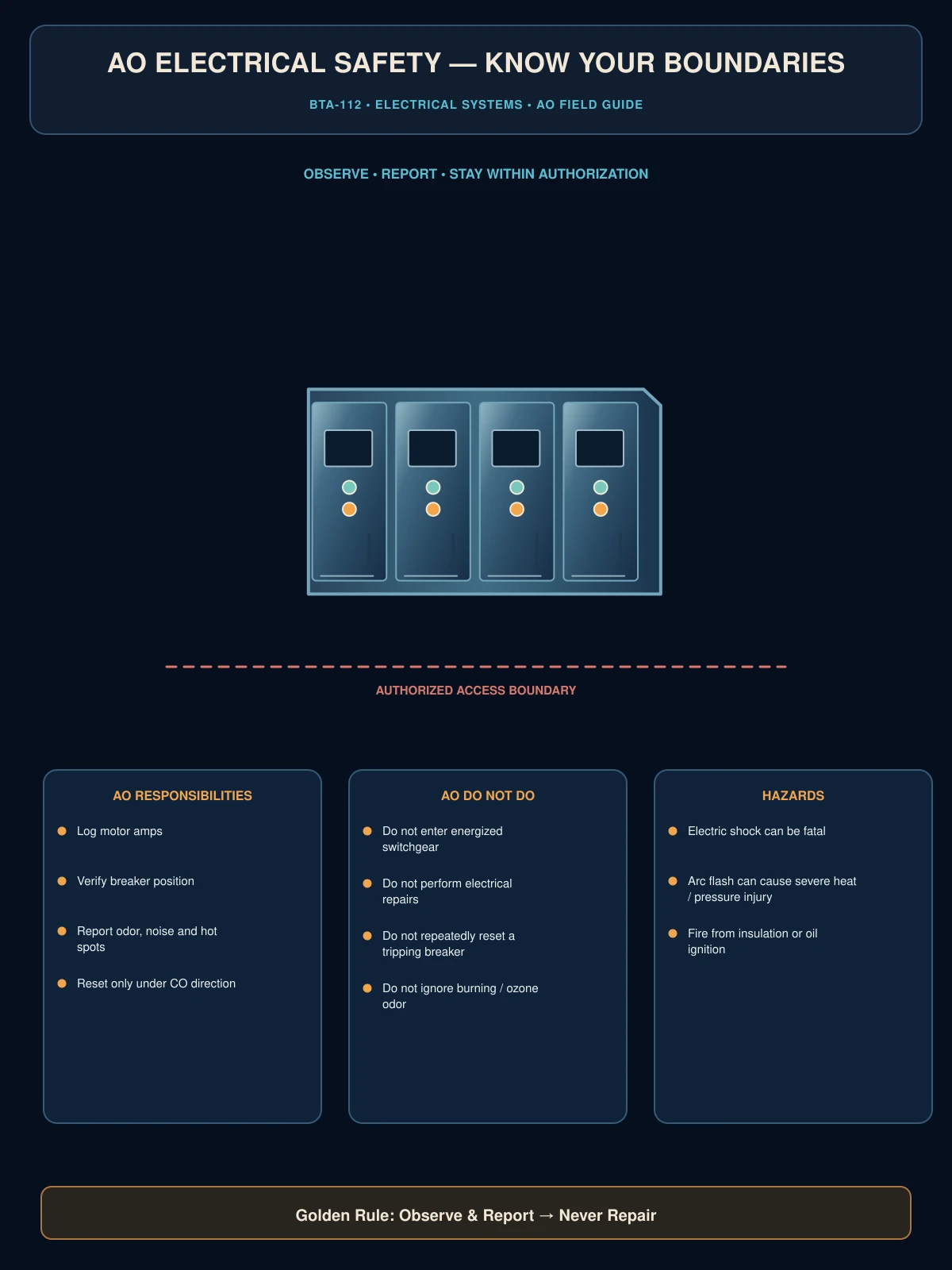
If a breaker trips, don't just reset it and move on, even if a reset seems to restore power successfully. A tripped breaker means the protection system detected something it was designed to detect. Report it and let it be investigated — closing back into an unresolved fault can cause far more serious damage the second time.
Motor Control Centers (MCCs)
A Motor Control Center is a modular assembly of individual motor starter units ("buckets"), each controlling one 480V motor or small load, all fed from a common bus. Each bucket typically contains a breaker or fused disconnect, a contactor (the switching device that actually starts/stops the motor), and overload protection sized to that specific motor. MCCs are how the plant distributes power to the majority of its smaller motors — cooling fans, small pumps, and auxiliary equipment throughout the plant.
- Bucket — an individual, typically removable unit within the MCC controlling one motor or load.
- Contactor — an electrically operated switch that repeatedly starts and stops the motor; unlike a breaker, it's designed for frequent switching under normal operation.
- Overload Relay — protects the motor itself from sustained overcurrent (like a jammed load) that isn't a short circuit but would eventually damage the motor windings from heat.
What This Means for Your Rounds
As an Auxiliary Operator, you're generally not performing electrical switching yourself, but you'll walk past switchgear and MCC rooms regularly, and unusual conditions there — an odor, an unusual sound, a warm cabinet, a tripped breaker indicator — are exactly the kind of thing your senses catch before an instrument does. Treat electrical rooms with the same attentiveness you'd give any other system on your route.
Ready to test what you just learned?