Water/Steam Chemistry
Why Water Chemistry Gets Its Own Module
Every plant type in this course — coal, combined cycle, and even the water side of a simple cycle plant's cooling systems — depends on carefully controlled water and steam chemistry. Poor chemistry doesn't usually cause a dramatic failure; it causes slow, expensive damage: corrosion that thins tubes over years, deposits that reduce heat transfer efficiency, and scale that eventually leads to tube failures costing millions of dollars and weeks of lost generation. Chemistry control is one of the least visible but most consequential jobs in the plant.
You already met several of these chemistry parameters in the plant-type modules — dissolved oxygen at the deaerator, condensate conductivity at the condenser. This module goes deeper into why those numbers matter and how the whole treatment chain fits together.
The Two Big Enemies: Oxygen and Dissolved Solids
Nearly everything in water/steam chemistry control comes down to fighting two problems:
- Dissolved oxygen causes corrosion wherever it contacts metal surfaces in the water/steam cycle. Raw water contains dissolved oxygen; the deaerator removes most of it thermally, and chemical oxygen scavengers mop up what's left.
- Dissolved solids and impurities — minerals, silica, and other contaminants — don't boil away with the water. As water evaporates to steam in a boiler or HRSG, dissolved solids concentrate in the remaining water. Left unchecked, they eventually deposit as scale on heat transfer surfaces (reducing efficiency and risking tube overheating) or carry over into steam, where they can damage turbine blading.
Following the Chain: Makeup to Steam
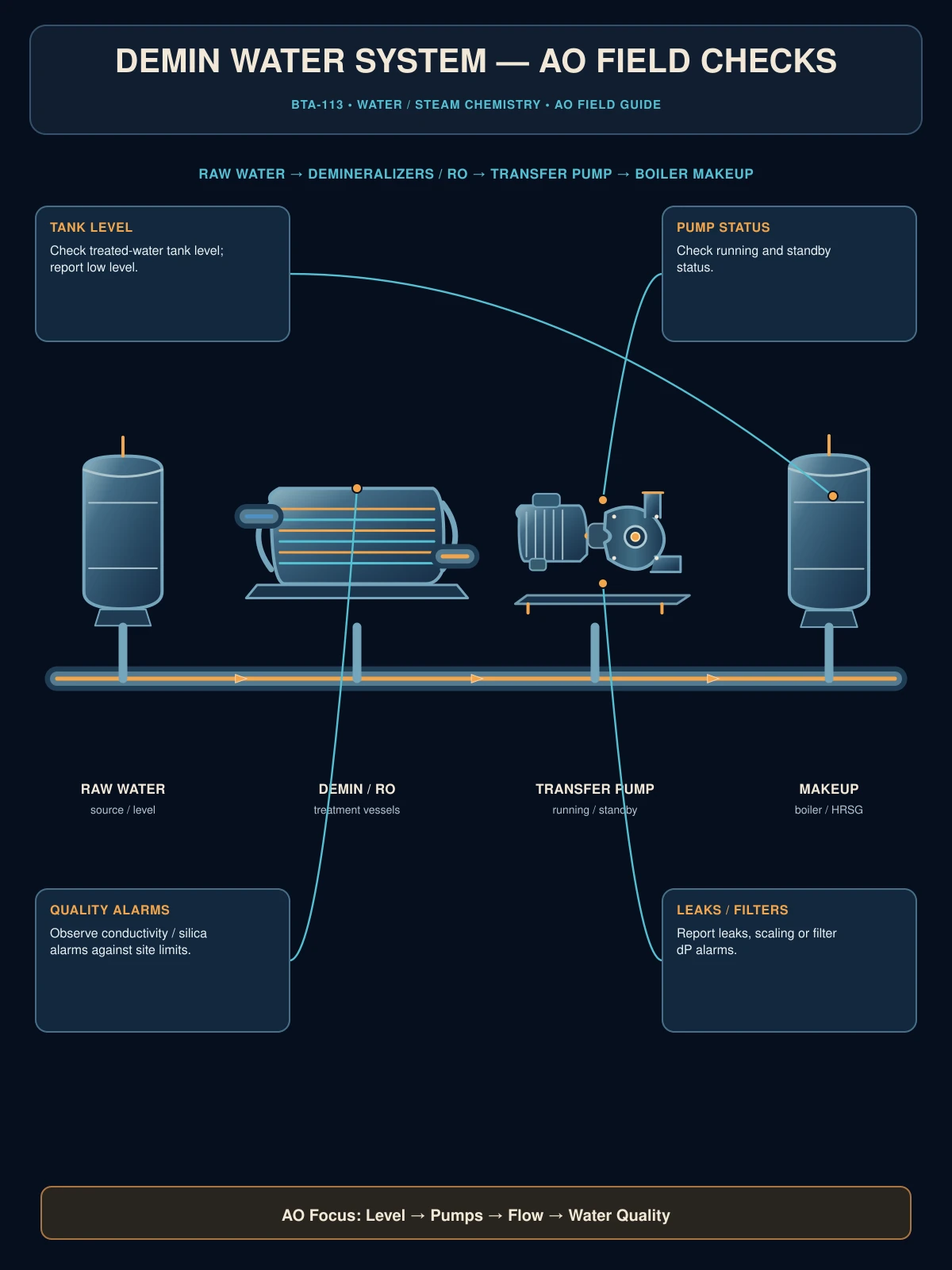
Fresh makeup water — needed to replace small ongoing losses in the water/steam cycle — first passes through a makeup water treatment system, typically demineralizers that strip out virtually all dissolved minerals, producing extremely pure water before it ever enters the main cycle. Within the cycle itself, a condensate polisher (found on many units, especially those without seawater or brackish cooling water) continuously removes any impurities from returning condensate, acting as a safety net against contamination from a condenser tube leak.
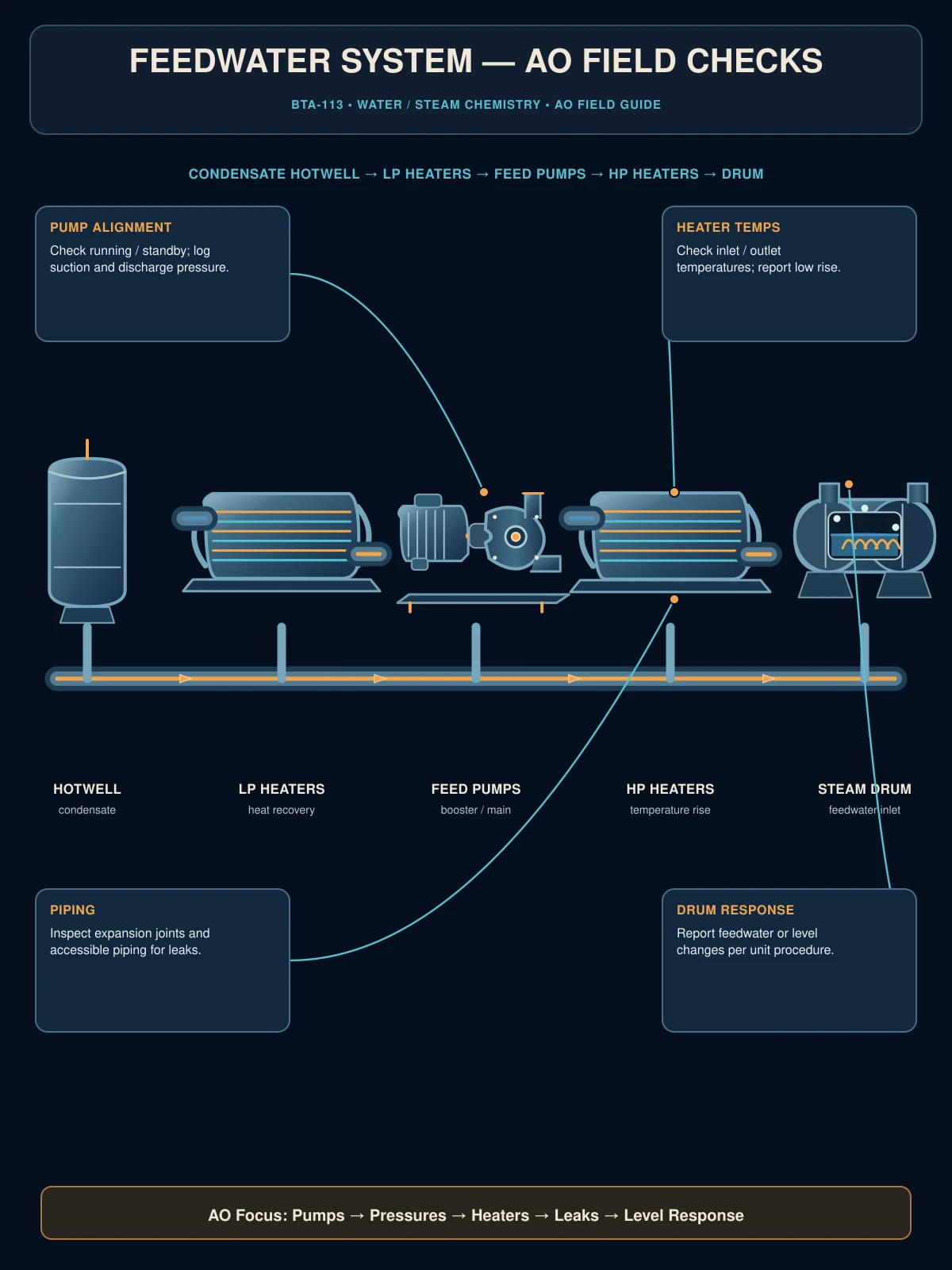
At the deaerator, heat and mechanical scrubbing strip out dissolved oxygen and other gases before feedwater continues to the boiler or HRSG. Chemical feed systems dose the water with oxygen scavengers (to remove any remaining trace oxygen), pH-adjusting amines (to keep the water slightly alkaline, which minimizes corrosion), and phosphates or other treatment chemicals depending on the specific chemistry program the plant uses.
Sampling and Monitoring
A continuous sample panel pulls small streams of water and steam from key points around the cycle — feedwater, drum water, and steam — cooling and reducing pressure so instruments (and chemists) can safely measure conductivity, pH, dissolved oxygen, and silica in near real-time. Drum/boiler sampling checks the concentrated water inside the boiler directly, while steam purity monitoring verifies that no carryover of dissolved solids is contaminating the steam headed to the turbine.
Chemistry problems are almost always gradual — a slowly rising conductivity trend over days or weeks, not a sudden spike. Continuous monitoring is what catches that gradual drift early enough to correct it before it becomes an actual equipment problem.
Blowdown: Managing Concentration
Blowdown is the deliberate, controlled removal of a small percentage of boiler or drum water, specifically to prevent dissolved solids from concentrating beyond acceptable limits as water continuously evaporates to steam. Blowdown rate is a genuine efficiency trade-off — too little, and dissolved solids build up and risk scale or carryover; too much, and you're discarding treated, heated water (and the energy used to treat and heat it) unnecessarily. Getting blowdown right, informed by good sampling data, is a real balancing act.
The Chemistry Lab and Your Role
Most plants have a dedicated chemistry lab (staffed by a chemist or chemistry-trained technician) that performs detailed periodic testing beyond what continuous online instruments cover. As an Auxiliary Operator, you're generally not doing chemistry testing yourself, but you'll often be the one collecting grab samples on a schedule, and you're in a position to notice things a chemist working from a lab wouldn't see directly — a leak near a chemical feed tank, an odor, or a sample panel that isn't flowing correctly.
Ready to test what you just learned?