Fuel Systems
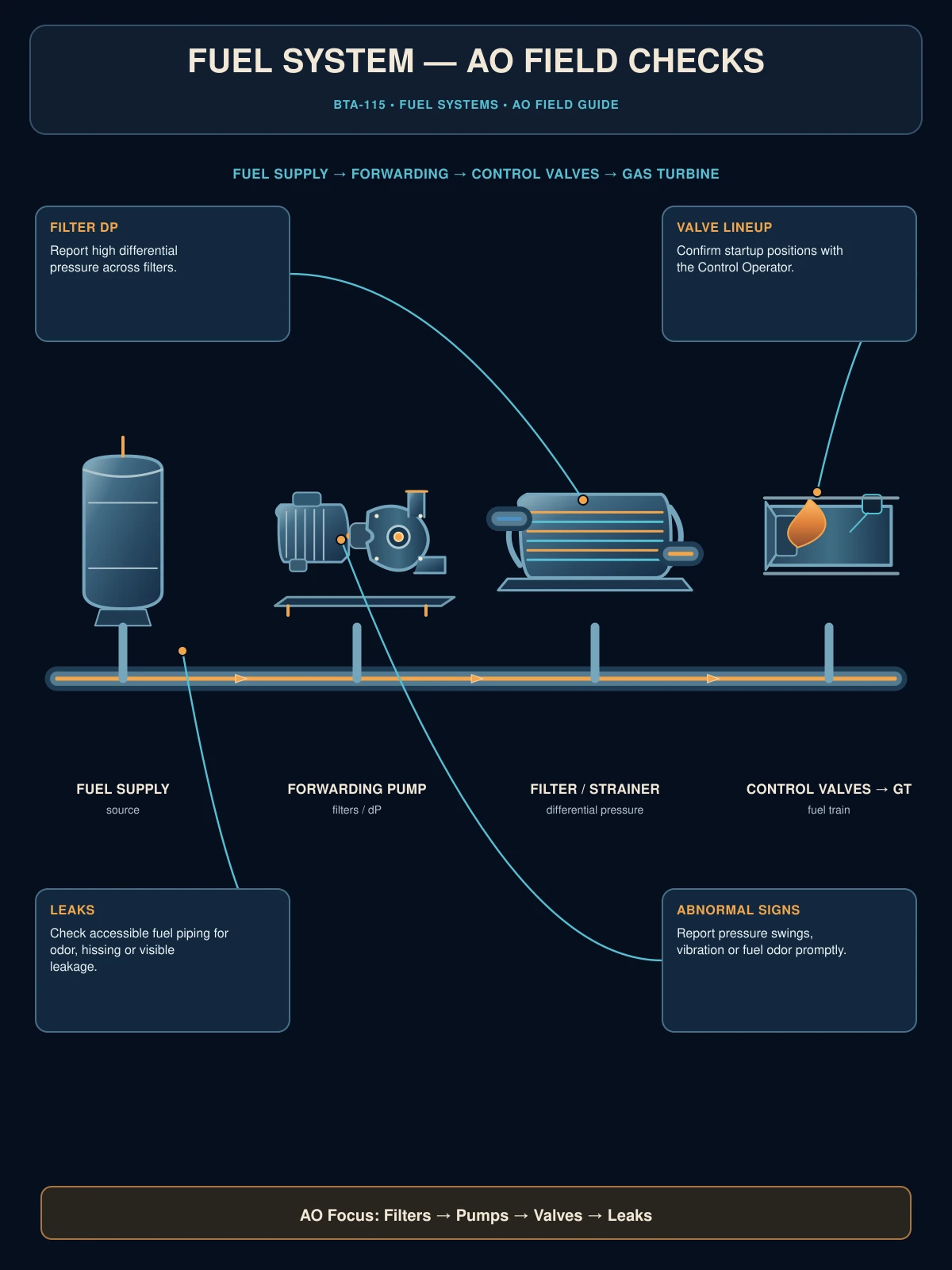
Bringing It Together
You've already met pieces of fuel systems in the plant-type modules — the fuel gas system in BTA-105/106, and coal handling in BTA-107. This module pulls those threads together, goes deeper on natural gas (the dominant fuel across most of this course), and adds liquid backup fuel systems, which many gas-fired plants rely on for reliability when pipeline gas isn't available or as a contractual requirement from the grid operator.
Natural Gas: From Pipeline to Combustor
Natural gas arrives from the interstate pipeline at high pressure — often 600 to 1,000+ psig — at a pipeline interconnect point that includes custody transfer metering (measuring exactly how much gas the plant is buying) and the first pressure regulation stage. From there, the gas passes through several conditioning steps before it's suitable for the combustor:
- Metering and pressure reduction — steps pressure down in stages to what the combustor actually needs, while continuously measuring flow for both control and billing purposes.
- Filtration/coalescing — removes any liquid droplets or particulate that made it through the pipeline, protecting sensitive downstream equipment and combustor hardware.
- Fuel gas heating — raises gas temperature above its dew point at the reduced pressure, preventing condensation that could otherwise form liquid droplets in the gas stream (pressure reduction alone cools a gas significantly, an effect called Joule-Thomson cooling).
Liquid condensation in fuel gas isn't just an efficiency concern — droplets reaching Dry Low NOx combustor hardware can cause combustion instability and damage costing millions of dollars to repair. The gas heater is a small piece of equipment protecting a very expensive piece of equipment downstream.
Gas Detection: A Continuous Safety Layer
Gas detection systems continuously monitor for combustible gas concentration (measured as a percentage of the Lower Explosive Limit, or LEL) throughout fuel gas skid areas and other locations where a leak could accumulate. These systems are tuned to alarm well before concentrations reach genuinely dangerous levels, giving time to respond. As an Auxiliary Operator, your own sense of smell remains a valuable, independent layer of protection alongside fixed detection — never dismiss a gas odor because "the detectors would have caught it."
Liquid Backup Fuel
Many gas-fired plants maintain a liquid fuel oil system — typically distillate (light) fuel oil — as backup for periods when pipeline gas isn't available, during curtailment, or to meet contractual dual-fuel capability requirements from the grid operator. This requires its own storage tanks, forwarding pumps to move oil from storage to the turbine, and often dedicated fuel oil combustor hardware (nozzles, in particular, often differ between gas and oil firing).
- Fuel oil storage — on-site tanks sized to provide a specified number of hours of full-load operation, per the plant's reliability requirements.
- Fuel oil forwarding pumps — move oil from storage tanks to the turbine's fuel oil skid, maintaining the pressure and flow the combustor requires.
Fuel Switching
A dual-fuel-capable unit can transfer from gas to oil (or back) while remaining online, a genuinely complex control sequence coordinating fuel valve positions, combustor hardware differences, and often a brief period of firing both fuels simultaneously during the transition. Fuel switches are relatively rare events but are treated with the same care as a startup — close monitoring for combustion stability and any signs of trouble during the transition.
Coal Handling: A Different Category Entirely
As covered in depth in BTA-107, coal-fired plants require an entirely separate fuel handling category — receiving, stockpiling, and pulverizing solid fuel rather than managing pressurized gas or liquid. It's worth remembering as a category distinction: gas and oil systems are about pressure, flow, and phase (liquid vs. vapor) control; coal handling is fundamentally a bulk materials handling operation with its own distinct hazards, covered fully in that earlier module.
Ready to test what you just learned?