Loading practice lab…
Rounds & Equipment Inspection
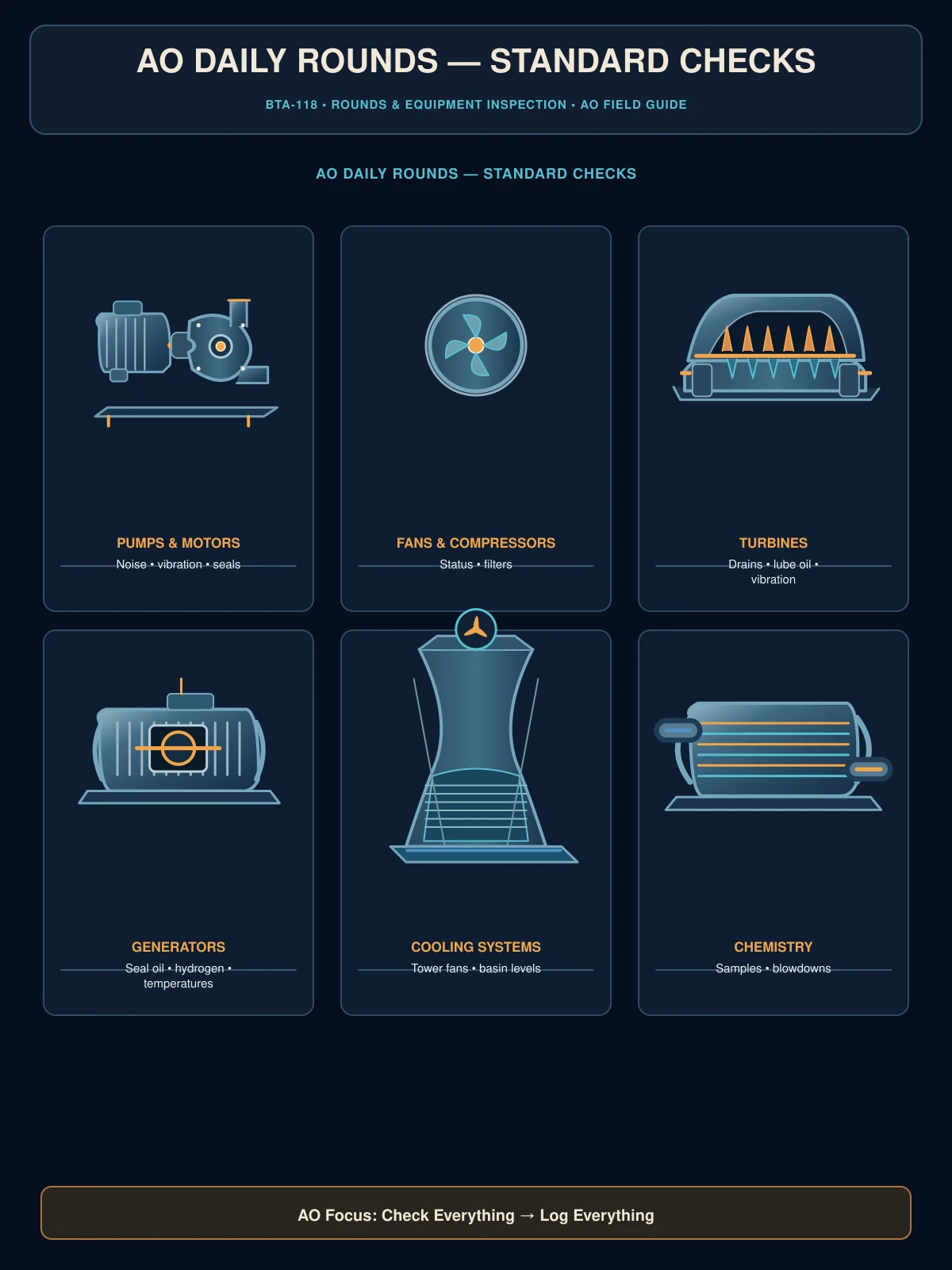
Applying What You've Learned
Every plant-type and core-systems module in this course included a "what to watch for" section — specific things to look, listen, and check for on each piece of equipment. This module steps back from any single system and teaches the methodology underneath all of those specifics: how to actually conduct a round in a way that catches problems early, consistently, and honestly.
BTA-102 introduced rounds as one part of the AO's shift. This module goes deeper into the technique itself — the difference between a round that technically gets completed and a round that actually catches problems comes down to the habits covered here.
Five Senses, One Discipline
Instrumentation tells you what it's specifically designed to measure. Your senses catch everything else — and a huge amount of early equipment trouble shows up first in ways no gauge is watching for:
- Visual — leaks, discoloration, unusual positions, physical damage, smoke or steam that shouldn't be there.
- Auditory — unusual sounds are often the earliest indicator of a developing mechanical problem, well before vibration or temperature instruments would alarm.
- Touch/thermal — unusual heat, vibration you can feel by hand (where safe to do so), texture changes.
- Smell — fuel, oil, ammonia, or overheating electrical insulation all have distinct odors that are often detectable before any instrument catches the underlying problem.
None of these senses replace instrumentation — they complement it. A gauge reading normal and something "seeming off" to your senses is worth investigating, not dismissing because "the number's fine."
Reading Instruments Correctly
Beyond simply recording a gauge value, effective instrument reading means understanding what that number actually means in context: is it within normal range for current load and ambient conditions? Has it moved since the last round? Gauges and local instruments sometimes fail or read inaccurately — cross-checking a suspicious local reading against a control room value, when possible, is a useful habit.
Trend Recognition: The Real Skill
A single reading is a snapshot; a series of readings over time is a trend, and trends are almost always more valuable than any single data point. Nearly every "what to watch for" item across this course describes a gradual trend, not a sudden event — rising vibration, slowly climbing temperature, a filter differential pressure creeping up. Recognizing a trend requires remembering (or recording) what you saw last time, which is exactly why consistent, honest documentation matters so much.
A single normal-range reading, viewed in isolation, hides a trend in progress. If a bearing temperature is 165°F today and it was 145°F last week and 130°F the week before, that's a meaningful trend even though 165°F might still be "within normal range." Comparing against history, not just against the alarm setpoint, is what catches problems early.
Route Discipline
A consistent route — checking the same equipment in the same order, every time — isn't bureaucratic rigidity; it builds the pattern recognition that makes trend spotting possible, and it ensures nothing gets skipped because of fatigue, distraction, or a shortcut that seemed reasonable in the moment. Deviating from a route occasionally to investigate something specific is fine and expected; skipping portions of a route routinely to save time defeats the entire purpose of rounds.
Knowing Your Baseline
Every experienced operator eventually develops an intuitive sense of what's "normal" for their specific equipment — not just the number on the gauge, but the sound, the smell, the feel of a healthy piece of equipment. This baseline knowledge is built through repetition and genuine attention over time, and it's what allows an experienced operator to notice something is subtly wrong before any instrument would flag it. There's no shortcut to building this — it comes from doing rounds carefully and consistently, round after round, for months and years.
Try the rounds challenge.
Ready to test what you just learned?